Emmélie Lempert: Chimera
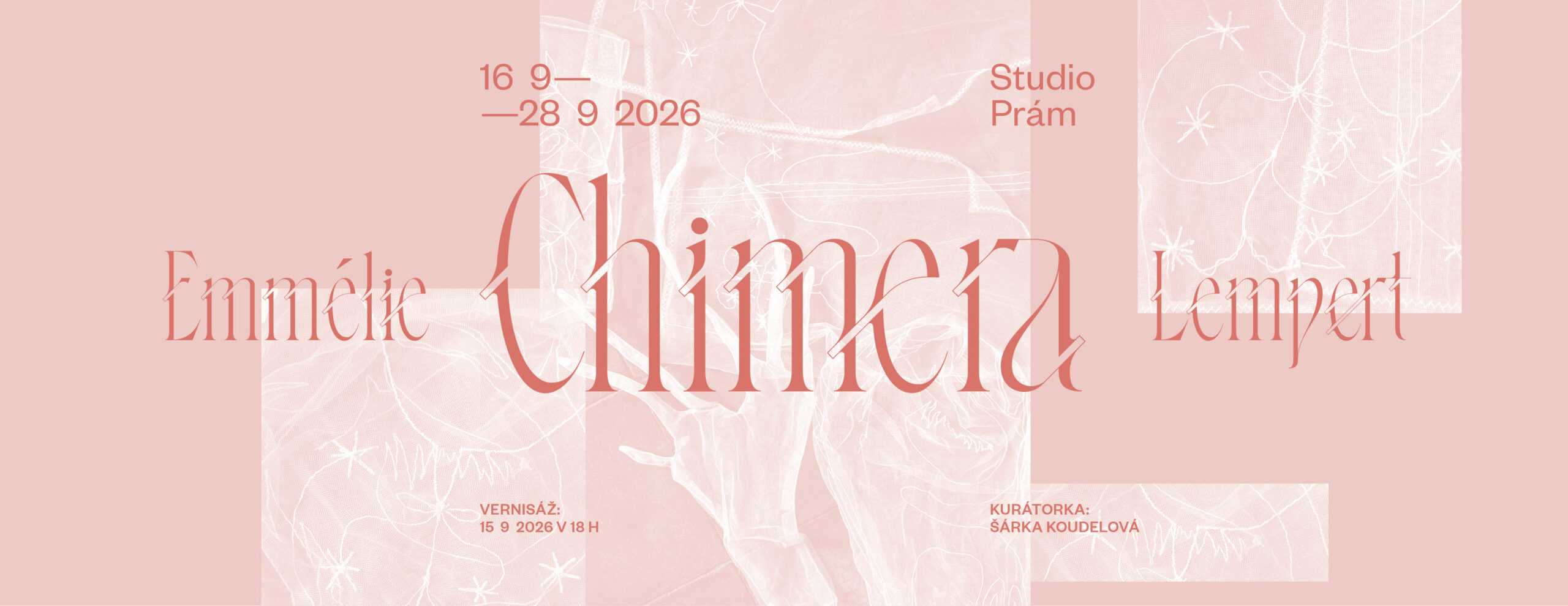
exhibition: 16. 9. – 28. 9. 2026
The two-dimensionality of the objects by German-Czech artist Emmélie Lempert confronts us with intimacy, idealization, and the transformation of the body. Pieces of historical underwear, gloves with an inhuman number of fingers, animalic balaclavas, and gothically pointed androgynous stockings—all pressed between two sheets of glass like last year’s flowers in a herbarium, but also like a sensual catalogue of the layers closest to human skin. For Emmélie, it is precisely the transformations of ideals of the human body that demonstrate that the desire to modify its shape is by no means a phenomenon of the present day. Throughout the ages, underwear has continually oscillated between two desires—that is, along a spectrum ranging from absolute comfort to sophisticated bodily modification. If the body, despite its heaviness, changeability, and smell, is a virtual chimera composed of our idea of it, of an ideal we consider different and better, and of the way it is perceived by those around us, then underwear, in its softness and transparency, but also its refinement and almost architectural construction, becomes a means of bringing all these bodies together into one.
Through her mode of presentation, Emmélie subconsciously evokes the visuality of Duchamp’s The Large Glass, as well as the no less iconic textile installations of Louise Bourgeois, reminiscent of oversized clothes racks holding garments prepared for different roles. By pressing meticulously sewn textiles between two sheets of glass set within a frame, she exposes every fold, every detail of the embroidery to our eyes—and at this moment we notice that the garments, in delicate flesh and ivory tones, bear traces of wear. We thus become witnesses to past bodily experiences whose intensity and location remain concealed from us. These performances without witnesses, in which Emmélie allows those close to her to “be dominated by a piece of clothing,” can therefore come alive in our imagination. Will we take the voyeuristic position of a secret observer, or will we put on a piece of underwear and accept its identity?
While working on her latest “collection” of garments, Emmélie leafed through Czech-German editions of books on Czech, Moravian, and Silesian folk costumes, drawing inspiration from them for the embroidery motifs decorating the white sleeves as well as other parts of the garments.
The minimalist installation, which allows the delicate layers to emerge, while also emphasizing how they are exposed to the eyes of the audience in all their intimacy and corporeality, is not merely a clever use of the spatial qualities of light. Emmélie consciously works with the body of the gallery, dressing it in a new layer. The formats of her works derive directly from the gallery’s architectural elements—its niches, openings, and windows. The linearity of the frames enters into dialogue with the drawing on the wall—a memory of the transformation of a body that is no longer here.
The project is implemented with financial support from City of Prague and State Fund of Culture of the Czech Republic.